
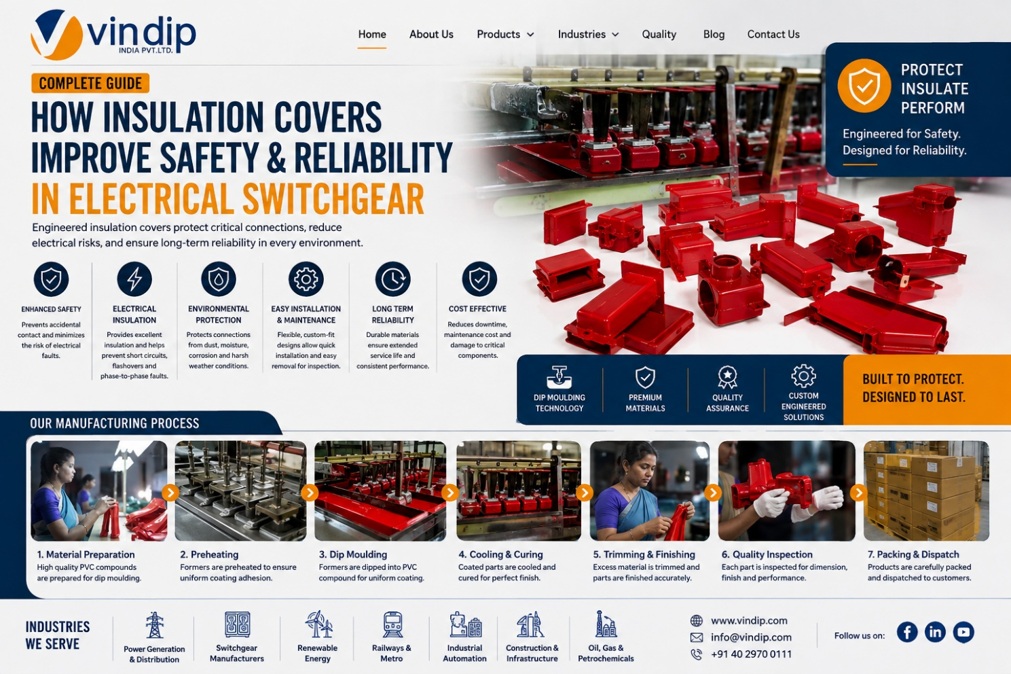
Electrical switchgear is one of the most critical parts of modern power distribution infrastructure. From industrial plants and commercial buildings to substations, renewable energy systems and utility networks, switchgear helps control, protect and distribute electrical power. However, the reliable operation of switchgear depends on much more than breakers, relays and conductors. The protection of exposed live parts, busbar joints, cable terminations and electrical connections is equally important.
This is where electrical insulation covers play a vital role.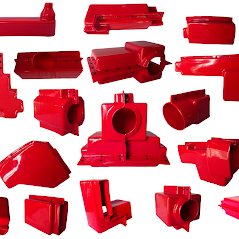
A properly designed insulation cover creates an additional protective barrier around critical electrical components. It helps reduce the possibility of accidental contact, phase-to-phase faults, short circuits, flashovers and environmental damage. At the same time, a flexible and properly fitted cover can improve installation efficiency and support easier maintenance.
For switchgear manufacturers, panel builders, utilities and maintenance teams, insulation should not be treated as a secondary consideration. It is an important part of a complete electrical protection strategy.
At Vin Dip India Pvt. Ltd., switchgear insulation solutions include custom-designed busbar boots, busbar shrouds and electrical insulation covers manufactured for different component geometries and applications. The company’s switchgear insulation solutions are designed for busbars, terminations and other critical electrical connections, with options for custom sizes and shapes for applications up to 36 kV. VinDip also offers PVC and silicone options depending on application requirements.
This complete guide explains, step by step, how insulation covers improve electrical safety, switchgear reliability and long-term operational performance.
- Understanding the Role of Insulation in Electrical Switchgear
Before understanding the importance of insulation covers, it is useful to understand the basic challenge inside switchgear.
Electrical switchgear contains multiple conductive components that may operate at different electrical potentials. These can include:
- Busbars
- Busbar joints
- Bolted connections
- Cable terminations
- Cable glands
- Connectors
- Lugs
- Terminals
- Breaker connections
- Live metallic parts
When these components are exposed, the possibility of an unintended electrical path increases. Under certain conditions, contamination, moisture, conductive objects, incorrect clearances or accidental contact can contribute to electrical faults.
The purpose of insulation is to provide electrical separation and reduce exposure to live conductive parts.
However, insulation in switchgear is not only about wrapping or covering a conductor. Effective electrical protection requires the correct combination of:
- Suitable insulation material
- Correct design
- Proper thickness
- Accurate fitment
- Appropriate voltage capability
- Resistance to the operating environment
- Reliable installation
This is why engineered insulation covers are often preferred for complex electrical connections and busbar joint geometries.
- What Are Electrical Insulation Covers?
Electrical insulation covers are protective components designed to cover or surround selected live electrical parts. Depending on the application, they may be known as:
- Busbar insulation covers
- Busbar boots
- Busbar shrouds
- Switchgear insulating shrouds
- Electrical connection covers
- Terminal insulation covers
- Cable gland shrouds
- PVC insulation boots
- Silicone insulation covers
VinDip’s busbar boots and shrouds are manufactured through a dip moulding process and are used to insulate switchgear connectors and busbar joints. The company states that these solutions can replace time-consuming taping methods and can be tailored to complex component geometries.
- Why Are Exposed Electrical Connections a Major Concern?
Electrical connections inside switchgear may have complicated shapes. A busbar system can include straight sections, bends, T-connections, L-connections and other customised joint arrangements.
Traditional insulation methods may become difficult when a connection has:
- Uneven surfaces
- Sharp bends
- Multiple bolted sections
- Complex joint shapes
- Limited installation space
- Different conductor sizes
In such situations, achieving consistent insulation coverage is important.
For example, an improperly covered busbar joint may leave exposed areas around a connection. During maintenance, there may also be a greater possibility of accidental contact with an exposed live part if the equipment has not been properly isolated and safety procedures are not followed.
A custom-fit insulation cover is designed specifically to follow the geometry of the component. This allows the cover to provide more complete physical coverage around the intended protected area.
The objective is not simply to “put a cover on a busbar.” The objective is to develop an insulation solution that fits the actual electrical component and its operating environment.
- How Insulation Covers Improve Electrical Safety
Step 1: They Create an Additional Barrier Around Live Parts
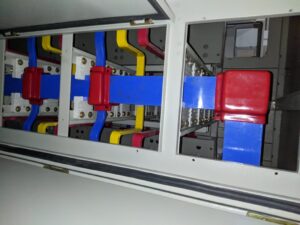
The first and most important benefit of an insulation cover is the additional physical and electrical barrier it provides around selected live components.
Busbars and electrical joints carry significant electrical energy depending on the system design. If conductive objects accidentally bridge two electrical potentials, a fault can occur.
By covering the intended exposed area, an insulation boot or shroud adds a protective layer between the live conductor and its surroundings.
This additional barrier can help reduce the risk associated with unintended contact.
Commonly protected areas include:
- Busbar joints
- Busbar connections
- Cable terminations
- Connectors
- Electrical terminals
- Cable gland areas
Step 2: They Help Reduce the Risk of Phase-to-Phase Contact
In multi-phase electrical systems, different conductors operate at different electrical potentials.
The physical separation and insulation of these conductors are essential.
Where busbars are positioned close to each other, an accidental conductive bridge between phases can result in a serious fault. Properly selected insulation covers add another level of separation around vulnerable joints and connections.
This is especially important in areas where:
- Multiple busbars are closely positioned
- Complex connections are present
- Conductive hardware is nearby
- Installation space is limited
- Maintenance activities are frequently performed
The exact insulation requirements must always be determined according to the electrical design, applicable standards, voltage level, clearances and system conditions.
Step 3: They Help Protect Against Accidental Contact
Safety in an electrical installation depends on multiple layers of protection.
One of those layers is reducing unnecessary exposure to live components.
During manufacturing, installation, inspection and maintenance, personnel may work near electrical assemblies. Engineered insulation covers can reduce the amount of exposed conductive surface around selected connections.
Of course, an insulation cover is not a replacement for proper electrical isolation, lockout/tagout procedures, PPE or established electrical safety practices.
Instead, it acts as an additional component within a broader electrical safety system.
A good safety strategy should include:
- Correct equipment design
- Proper insulation
- Suitable clearances
- Protective devices
- Safe installation
- Isolation procedures
- Inspection and maintenance
- Trained personnel
- Compliance with applicable standards
Insulation covers support this overall strategy by improving protection around critical live parts.
- How Insulation Covers Improve Switchgear Reliability
Electrical safety and electrical reliability are closely connected.
A switchgear fault can cause more than equipment damage. It may also result in:
- Unexpected downtime
- Production losses
- Maintenance costs
- Equipment replacement
- Service interruption
- Damage to connected systems
By improving protection around selected electrical connections, insulation covers can contribute to a more reliable electrical system.
Let’s examine this step by step.
5.1 Protection of Critical Busbar Connections
Busbar joints are important electrical connection points. Their design and condition directly affect the performance of the distribution system.
A well-designed insulation cover protects the surrounding area of the joint and helps reduce exposure to external contamination.
For complex busbar configurations, custom-moulded boots can be developed for shapes such as:
- Straight joints
- L-joints
- T-joints
- Elbow connections
- Special customised connections
This ability to match the shape of the actual component is one of the major advantages of custom electrical insulation solutions.
Instead of forcing a standard product onto a non-standard component, the insulation cover can be engineered around the required geometry.
5.2 Reduced Dependence on Manual Taping
Electrical tape may be used in certain applications, but manually applying tape to complex electrical joints can require time and careful workmanship.
The consistency of the result can depend on:
- The technician’s installation method
- The number of layers applied
- Overlap consistency
- Access to the joint
- The shape of the component
For repeated production of the same switchgear design, a custom insulation boot or shroud can provide a more repeatable fitment process.
VinDip specifically identifies busbar shrouds as an alternative to labour-intensive taping for switchgear and busbar connections. The company’s dip-moulded products are designed for easier installation, removal and reinstallation where the application requires maintenance access.
For OEM switchgear manufacturers, repeatability can be particularly valuable when producing multiple panels or assemblies with the same component design.
5.3 Protection from Dust and Contamination
Electrical equipment operates in a wide range of industrial environments.
Depending on the installation, the surrounding environment may contain:
- Dust
- Dirt
- Industrial contaminants
- Moisture
- Chemical exposure
The environmental conditions and required ingress protection will vary by application.
Insulation covers can help shield selected electrical connections from direct exposure to certain contaminants when properly designed and applied. However, a cover should not automatically be assumed to provide complete environmental sealing unless it has been specifically designed and tested for that purpose.
This distinction is important.
A busbar insulation cover is primarily an electrical insulation and protective component. If an application also requires a defined level of environmental sealing, the product design must address that specific requirement.
- The Importance of Proper Fitment
An insulation cover is only effective when it is designed and installed correctly.
A loose or incorrectly sized cover may create problems during installation or operation. A cover that does not match the actual component geometry may leave areas insufficiently protected.
For this reason, the design process should begin with accurate technical information.
The following details are normally important:
Component dimensions
Accurate dimensions are required for correct fitment.
Connection geometry
The designer should understand whether the connection is:
- Straight
- L-shaped
- T-shaped
- Elbow-shaped
- Multi-directional
- Completely customised
Voltage level
The insulation solution must be selected for the actual electrical application.
Operating environment
The product requirements may differ between:
- Indoor switchgear
- Outdoor switchgear
- Substations
- Industrial facilities
- High-humidity locations
- High-temperature areas
- Areas exposed to UV radiation
Material requirements
The required material properties may include:
- Dielectric performance
- Flexibility
- Flame retardancy
- UV resistance
- Weather resistance
- Temperature capability
- Mechanical durability
Installation requirements
The cover should be designed so that it can be installed correctly around the intended component.
- PVC vs Silicone Insulation Covers: Why Material Selection Matters
There is no single material that is best for every electrical application.
The correct choice depends on the actual operating conditions.
PVC Insulation Covers
PVC-based flexible insulation covers can offer:
- Good flexibility
- Custom mouldability
- Good fitment around complex shapes
- Suitable electrical insulation properties for designed applications
- Flame-retardant formulations where required
- Cost-effective production for many applications
VinDip manufactures switchgear shrouds using PVC and also offers silicone boots to provide additional options depending on customer requirements.
PVC dip moulding is particularly useful for producing seamless custom-shaped components.
Silicone Insulation Covers
Silicone may be selected for applications requiring different environmental or temperature performance characteristics.
Depending on the formulation and product design, silicone insulation covers can be considered for demanding applications involving factors such as:
- Higher temperature requirements
- Outdoor exposure
- UV exposure
- Long-term weathering requirements
However, material selection should always be based on engineering requirements rather than simply choosing the material that sounds more advanced.
The correct question is:
What material and design are suitable for this specific voltage, temperature, environment and installation requirement?
That is the approach that helps achieve reliable long-term performance.
- The Role of Custom Dip Moulding in Switchgear Insulation
Standard products are useful when the component dimensions are standard.
But electrical equipment is often customised.
Different OEMs may use different:
- Busbar dimensions
- Connection designs
- Bolt positions
- Joint shapes
- Equipment layouts
- Clearance requirements
This creates a need for customised insulation solutions.
Dip moulding provides an effective manufacturing method for producing flexible, custom-shaped covers.
The general development process can be understood as follows.
Step 1: Understand the Application
The manufacturer first studies the application requirements.
Important questions include:
- What component needs to be insulated?
- What are the dimensions?
- What is the connection shape?
- What voltage is involved?
- Is the application indoor or outdoor?
- What environmental conditions are expected?
- Are special material properties required?
This stage is critical because an incorrect understanding of the application can lead to an incorrect product design.
Step 2: Develop the Design
Based on the component geometry, the insulation cover is designed to achieve the required fitment.
The design may consider:
- Internal dimensions
- Wall thickness
- Openings
- Connection points
- Flexibility requirements
- Installation direction
- Retention and grip
- Required coverage area
For custom projects, engineering drawings and actual component samples can help improve accuracy.
Step 3: Tool and Prototype Development
Once the design is finalised, a tool or mandrel is developed based on the required shape.
A prototype can then be evaluated for:
- Fitment
- Ease of installation
- Coverage
- Dimensional accuracy
- Functional requirements
This stage helps identify potential issues before mass production.
VinDip describes its development process as including design collaboration, prototyping and in-house tool development, supporting customised dip-moulded components.
Step 4: Production
After the design and fitment are approved, the insulation covers can be produced according to the defined manufacturing process.
For dip-moulded PVC components, the process enables the production of seamless covers that can follow complex shapes.
Consistency in manufacturing is important for OEM applications because every cover should fit the corresponding component within the required tolerances.
Step 5: Quality Verification
Quality verification should be based on the product’s actual requirements.
Depending on the application, this may involve checks related to:
- Dimensions
- Fitment
- Wall thickness
- Mechanical properties
- Electrical insulation performance
- Dielectric strength
- Visual quality
- Material properties
VinDip states that its facility uses in-house equipment including a high-voltage breakdown tester, universal testing machine and insulation testing equipment for relevant insulation performance and mechanical verification.
- Key Areas Where Insulation Covers Are Used in Switchgear
Electrical insulation covers can be used in multiple locations depending on equipment design.
Busbar Joints
Busbar joints are among the most common applications.
Covers can be designed for:
- Straight joints
- L-joints
- T-joints
- Elbow joints
- Custom connections
These covers help provide insulation around complex connection geometries.
Busbar Terminations
Busbar ends and termination areas may require protection depending on the design.
A properly designed cover can provide an insulating barrier around the selected termination area.
Cable Connections and Lugs
Cable connection points can contain exposed conductive parts.
Custom insulation covers may be developed to fit specific lug and terminal configurations.
Cable Glands
Cable glands can be exposed to dust, corrosion and environmental conditions depending on the installation.
VinDip’s PVC cable gland shrouds are designed to provide protection for metallic cable glands against damage, dust and corrosion.
Control Panels
Control panels may contain numerous electrical terminals and connections in a compact space.
Correctly selected insulation components can help improve protection around critical live parts while maintaining accessibility for installation and maintenance.
- Indoor and Outdoor Applications Require Different Considerations
One of the most common mistakes is assuming that an insulation cover suitable for indoor use is automatically suitable for outdoor exposure.
Outdoor installations may face additional challenges such as:
- UV radiation
- Rain
- Moisture
- Temperature changes
- Pollution
- Dust
- Wildlife interaction
Therefore, outdoor insulation solutions must be selected specifically for the expected environment.
VinDip offers insulation solutions for both switchgear and utility applications, including UV-stabilized and weather-oriented protective solutions for applicable outdoor products.
For any outdoor project, the buyer or design engineer should clearly define:
- The operating voltage
- The environmental exposure
- Temperature range
- UV exposure requirements
- Required material properties
- Required testing
- Applicable standards
This information helps ensure that the product is designed for the real operating environment rather than simply selected by appearance.
- How Insulation Covers Support Easier Maintenance
Electrical equipment requires inspection and maintenance throughout its service life.
A practical insulation solution should consider not only initial installation but also future access.
Where the application allows, flexible moulded insulation boots can be designed to:
- Install easily
- Fit securely
- Be removed when maintenance is required
- Be reinstalled after inspection
This can offer advantages compared with repeatedly applying and removing manual insulation materials.
However, maintenance personnel must always follow approved electrical safety procedures. The presence of an insulation cover does not make live electrical equipment safe to touch.
Proper isolation, verification of absence of voltage and site-specific safety procedures remain essential.
- Why Custom Fitment Is Important for OEM Switchgear Manufacturers
For an OEM, consistency is extremely important.
When hundreds or thousands of electrical assemblies are produced, the insulation component must fit correctly every time.
Custom moulded insulation covers can support:
- Repeatable dimensions
- Consistent fitment
- Faster assembly
- Standardised protection
- Improved product appearance
- Reduced dependence on manual wrapping
VinDip has developed thousands of custom dip-moulded parts and offers custom-engineered shrouds for electrical insulation applications. Its switchgear product range includes standard and tailor-made solutions for OEM and utility requirements.
For a switchgear manufacturer, this means the insulation component can be treated as an engineered part of the overall assembly rather than an afterthought added at the final stage.
- The Future of Switchgear Protection
Electrical infrastructure is becoming increasingly important as power demand grows across:
- Manufacturing
- Data centres
- Renewable energy
- Transportation
- Commercial infrastructure
- Utilities
- Smart grid systems
As systems become more complex, the demand for reliable electrical protection also increases.
Future switchgear insulation solutions will continue to focus on:
- Better material performance
- More precise custom fitment
- Faster installation
- Improved environmental resistance
- Advanced testing
- Higher manufacturing consistency
- Solutions for increasingly compact electrical systems
The objective remains the same:
Protect critical electrical components, reduce unnecessary exposure to fault risks and support reliable operation.
Electrical insulation covers may appear to be simple components, but their role in switchgear can be extremely important.
A correctly designed busbar boot, insulation shroud or electrical connection cover can provide an additional protective barrier around critical live parts. It can help reduce exposure to accidental contact, support separation around vulnerable connections, protect selected components from environmental contamination and improve the consistency of insulation across repeated switchgear assemblies.
The key to successful performance is not simply buying an insulation cover.
It is selecting the right cover for the right application.
At Vin Dip India Pvt. Ltd., customised busbar boots, shrouds and electrical insulation covers are developed to meet specific switchgear and electrical application requirements. With experience in dip moulding and custom component development, VinDip supports OEMs and electrical manufacturers with insulation solutions designed around actual component geometry and performance needs.
Because in electrical systems, reliable protection begins with attention to every connection.
Frequently Asked Questions About Electrical Insulation Covers for Switchgear
- What is an insulation cover in switchgear?
An insulation cover is a protective component designed to cover selected live electrical parts such as busbar joints, terminals and connections. It provides an additional insulating barrier and helps reduce unnecessary exposure to live conductive surfaces.
- What are busbar boots?
Busbar boots are moulded insulation covers designed to fit around busbar joints, connections and other electrical components. They may be available in standard shapes or customised according to the component geometry.
- How do busbar shrouds improve electrical safety?
Busbar shrouds provide an additional insulating barrier around selected live connections. They can help reduce the risk associated with unintended contact or conductive bridging, subject to correct system design, installation and application requirements.
- Are PVC insulation covers suitable for all applications?
No. Material selection depends on the voltage, temperature, environment, mechanical requirements and other application conditions. PVC may be suitable for many applications, while silicone or other materials may be required for different operating conditions.
- Can insulation covers be customised?
Yes. Custom insulation covers can be developed according to drawings, dimensions, component samples and technical specifications. Customisation is particularly useful for complex busbar joints and non-standard electrical connections.
- What information is required to develop a custom busbar boot?
Useful information includes the component drawing, dimensions, voltage application, joint shape, operating environment, required material properties and expected quantity.
- Are insulation covers a replacement for electrical safety procedures?
No. Insulation covers are only one part of an overall electrical protection strategy. Proper isolation, safe work procedures, PPE, equipment design and applicable electrical safety requirements must always be followed.
- What is the difference between a busbar boot and a busbar shroud?
The terminology can vary by manufacturer and application. Both generally refer to insulating protective components used around busbar joints and electrical connections. The exact design, shape and intended coverage may differ.
- Can insulation covers be used outdoors?
Some insulation covers are specifically designed for outdoor environments. Outdoor applications must consider UV exposure, weather, temperature and other environmental conditions. Always select a product specifically designed for the intended environment.
- How can I choose the right switchgear insulation cover?
Start by defining the component dimensions, connection geometry, voltage, operating environment, material requirements and installation conditions. Then select or develop a cover based on those specific engineering requirements.